

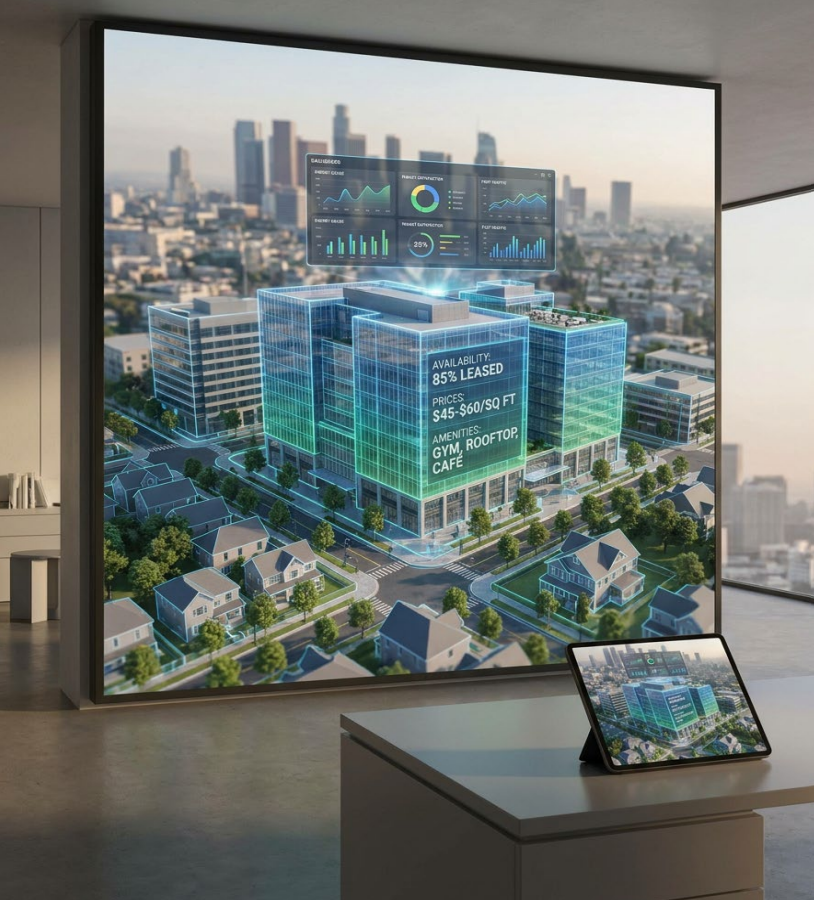
The sale of a real estate project, especially in the pre-sale or off-plan phase, has historically depended on the buyer's ability to abstract. The process is usually the same: an advisor spreads out on a table or shares on a screen a technical plan full of lines, dimensions, and symbols that the average client does not know how to interpret. To compensate for this disconnect, static renderings are used. However, in today's market, this traditional formula has met its technical and commercial limit in an invisible but critical problem: the radical fragmentation of information.
When information is scattered, the sales thread breaks constantly. Let's imagine the experience of a client trying to understand their future home. The advisor shows them a supporting rendering of the living room, but that rendering corresponds to type A among other apartment typologies in the project. If the client is interested in type B, which has a U-shaped kitchen or an island instead of an L-shaped kitchen, then the rendering's visual is no longer useful. The buyer is forced to make a tremendous mental effort to project how that space will change, how the rooms, the layout of the bathrooms, or the depth of the closets will look in the specific layout they are going to pay for.
This disconnect is aggravated when we try to look at the project as a whole. A client does not only care about the interior of their apartment; they need to know where their property is located relative to the rest of the project. They want to understand which floor they will be on, where on the facade it is located and, crucially, what actual view they will have at sunrise or sunset. With traditional tools, answering this implies jumping to a facade plan, then to a tower layout diagram, and then to an aerial photograph taken with a drone. Once again, the experience is fragmented.
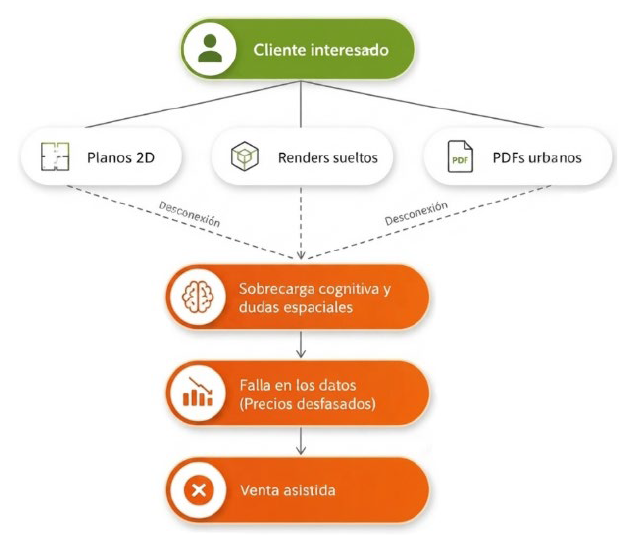
The problem reaches its peak when we move from the building to the Master Plan. Modern developments are not islands; they are complex urban interventions that integrate streets, parks, commercial areas, and services that feed back into each other. Explaining the long-term value of this urban synergy through a flat zoning map is almost impossible. The buyer fails to grasp how that large park or commercial area will positively affect the surplus value and lifestyle of their asset. And in the real estate sector, an implacable maxim rules: what is not clearly understood generates doubts, and doubt never adds to the value of the asset; on the contrary, it subtracts confidence and freezes the purchase decision.
There are cases where, to this visual chaos, a lack of operational synchronization is added. In a traditional sales room or an independent broker network, commercial data usually lags behind. A client can spend two hours falling in love with a specific unit, visualizing their life in it, only for the advisor to discover when blocking it that it was sold days ago by another sales team. The lost time and generated frustration destroy the customer experience.
This is where the Digital Twin breaks in, not as a visual accessory, but as the ultimate commercial infrastructure: the great integrator. A digital twin is not a collection of renderings; it is a living, three-dimensional, and continuous replica of the project and its surroundings. For the first time, all geometric, spatial, and urban information coexists in a single digital ecosystem without transitions or loading screens.
The user can perform a zoom in to a level of detail that allows them to explore how sunlight interacts with their kitchen island or inspect the design of their closet, and with a smooth mouse movement, zoom out completely to rise above the tower, verify its orientation on the facade, check the exact view from their balcony, and understand in a single glance how their tower connects to the avenues and parks of the entire master plan of the city. All of this happens while the digital model is fed in real-time from a live database that communicates exact availability, updated prices, and areas, eliminating human stock errors.
Throughout this article, we will analyze in depth how the Digital Twin solves the fragmentation of information at its root to become the most powerful sales engine in the real estate sector. We will discover the mechanisms through which providing absolute spatial clarity eliminates buyer uncertainty, drastically shortening decision and sales closing times. Finally, we will explore how this technology democratizes access to the market, allowing a large-scale project to be experienced, understood, and bought with complete confidence by investors in any corner of the planet, transforming a local sales room into a platform of global reach.
What exactly is a digital twin in the real estate sector?
To understand its commercial power, it must first be demystified: a digital twin is not a hyper-realistic video render, nor a 360° photo. It is a virtual, three-dimensional, exact, and interactive replica of an architectural project and its surroundings, connected to real data.
From a technical standpoint, this tool is born from taking rigorous blueprinting, BIM models (like Revit), or volumetrics in 3ds Max, and combining them with cadastral data and geographic information systems (GIS). All this technical rigor is processed through real-time graphics engines—such as Unreal Engine 5—to create a living environment. The result is an ecosystem where the client can walk freely, open doors, change the finishes of a kitchen in real-time, visualize the exact solar incidence at 4:00 p.m., and have an absolute understanding of the space. It is not an artistic representation of what could be; it is a mathematical and visual simulation of what will be with greater accuracy.
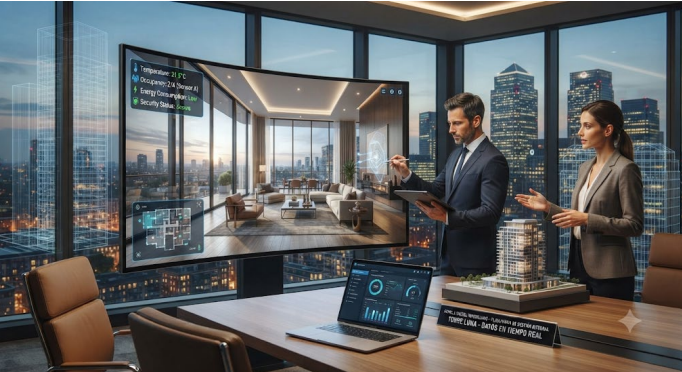
Speeding Up Sales: Less Friction, More Closings
If we recall the wear and tear of traditional sales, the biggest obstacle to closing a deal is doubt. The digital twin attacks this problem by eliminating the need for the client to "imagine" things.
• Immediate spatial clarity: If a project has ten apartment typologies, the client no longer has to see the rendering of one and imagine the other. They can enter *their* exact typology, walk down the hallway, size the real closet space, and look out the balcony to check the real view their floor will have.
• Commercial synchronization: By being connected to a live database, the digital twin works as the central inventory. While the client explores the tower, they can see in real-time which units are available, which are reserved, and what the updated price of the unit or lot is. This eliminates human errors, accelerates the sense of urgency, and enables smooth transactions on the same platform.
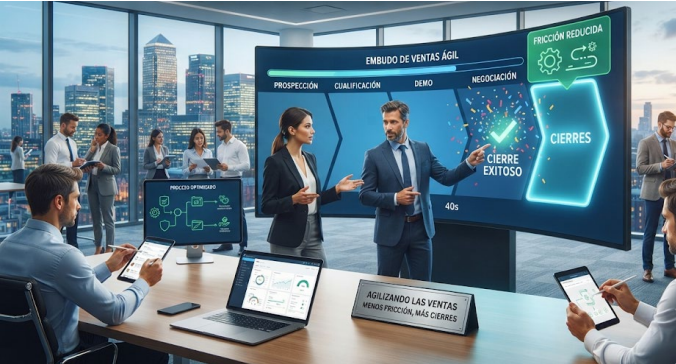
Breaking Borders: Projects on a Global Scale
Perhaps the most disruptive impact of the digital twin is how it expands a developer's market. The physical sales room is no longer the limit.
Let's imagine an urban macro-project or a master plan designed under the concept of the '15-minute city'. Explaining the appreciation of this level of infrastructure to an investor who is thousands of miles away is a huge challenge using only 2D plans. However, with a digital twin, that foreign investor can virtually 'land' on the project. They can travel the main roads, understand the urban subdivision, see how residential areas connect pedestrianally with commerce, and size the real scale of parks and mixed zones.
The project becomes exportable and interactive 24/7. By democratizing access to space, real estate developers can capture capital from anywhere in the world, competing in the major global leagues with a tool that transmits confidence and absolute transparency.
Success Case: Meraki and the Challenge of Selling Luxury and Lifestyle on a Global Scale
To ground the real power of this technology, let's analyze a real case study: Meraki is a luxury real estate development located in Cartagena. This project presented a fascinating and highly complex commercial challenge, since its target audience was mainly foreign investors and Colombians residing abroad who were looking for a very high-end retirement plan.
Reaching this niche required much more than sending a digital brochure. Meraki needed to transmit an image of absolute exclusivity thousands of miles away. This exclusivity was reflected in the architectural design through varied and unique typologies for each unit; a highly valuable differential for the luxury buyer, but a commercial nightmare if sold with traditional renderings, as the client demanded to see exactly the details of *their* apartment, not the one in the neighboring tower.
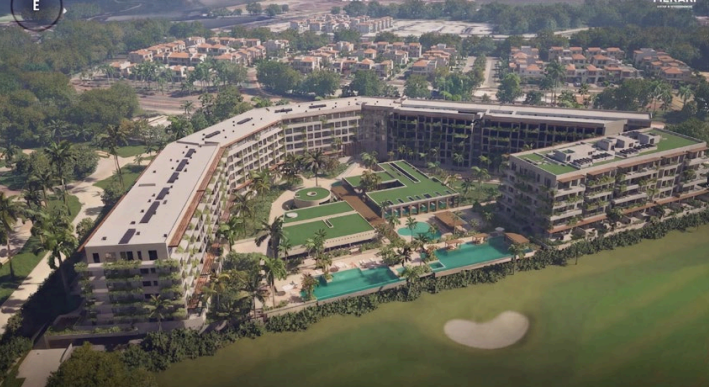
The solution was to develop a comprehensive digital model that achieved three fundamental milestones for closing sales:
- The personalization of exclusivity: The digital twin allowed each client, from their screen in Miami, Madrid, or New York, to tour and interact with their specific typology, perfectly understanding the unique distribution of their future home without having to set foot in Cartagena.
- The "Luxury Resort" Ecosystem: Meraki has more than 20 first-class amenities. Showing them in isolated images diluted the concept. The digital model integrated all these spaces into a single continuous tour, allowing the buyer to size the project comprehensively and feel that they were investing in a true ecosystem of comfort, not just a building.
- The sale of the urban environment and lifestyle: Selling luxury and lifestyle implies selling the surroundings. The digital model broke the project's walls and three-dimensionally recreated the entire environment of the Serena del Mar macro-development, visualizing access roads, golf courses, and the main urban landmarks.
With this strategy, the digital twin ceased to be a simple representation of the building to become an immersive window to the Caribbean lifestyle. The uncertainty of distance was 100% mitigated, the exclusivity of each design was made tangible, and the value of the asset was justified by visually connecting it with the prestigious urban development of Serena del Mar.
Conclusion
The real estate sector has relied for decades on a limiting premise: selling a future promise required that the client make an act of faith. However, in an increasingly competitive and globalized market, faith and imagination are no longer enough to close high-value business. Doubt is the greatest enemy of sales, and as we have seen, traditional tools—with their fragmented and static information—feed that uncertainty.
Digital twins represent the end of that era. We are no longer talking about architectural visualization; we are talking about strategic commercial infrastructure. By unifying technical plans, interactive tours, urban environments, and real-time databases within a single living ecosystem, the digital twin transforms the promise into an experienceable reality.
The benefits are clear: sales are streamlined because the client understands exactly what they are buying, from the light that will enter through their window to the impact of the master plan on their quality of life. And at the same time, geographical boundaries disappear. A project is no longer anchored to the physical visitors of its sales room; it becomes a global asset, ready to be explored and acquired by investors from any part of the world with absolute confidence.
In short, the integration of digital twins is no longer science fiction or a simple 'value add' aesthetic. It is the new standard. Firms and developers that adopt this technology will lead the market, speaking the language of certainty and transparency. Those who do not will continue trying to explain a three-dimensional world with paper plans.